
Arcane Odyssey Brewing Guide: Potions, Ingredients, and Skill
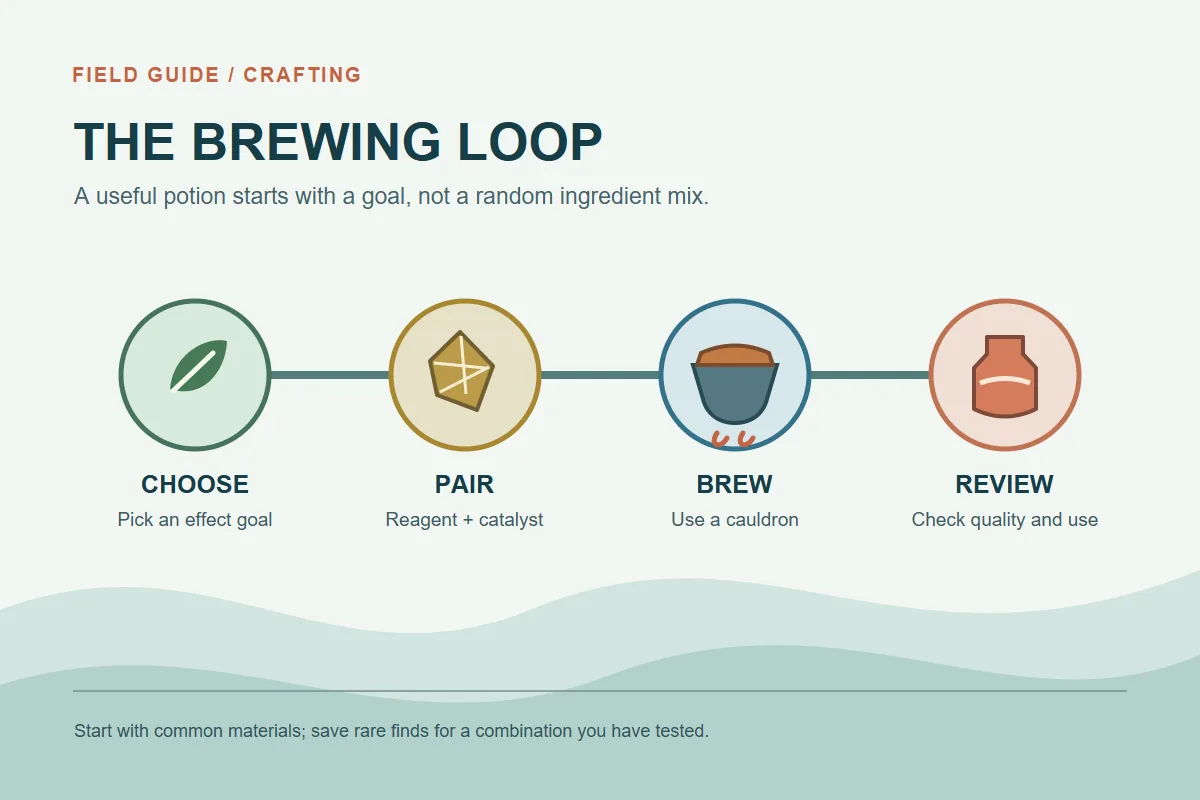
This Arcane Odyssey brewing guide starts with a practical rule: brewing turns reagents and catalysts into potions at a cauldron. To avoid wasted materials, decide what effect you need first, check what each ingredient controls, and test a low-cost combination before using rare finds.
Published and checked | By Arcane Tools Editorial Team
What Arcane Odyssey Brewing Produces
Brewing is a profession and crafting system. For this Arcane Odyssey brewing guide, start with one rule: at a cauldron, you combine a reagent with a catalyst to create a potion. Potions can carry positive, neutral, or negative status effects, so the result is not automatically useful just because the ingredients were rare. Decide whether you want a buff, a utility effect, or a way to apply pressure before you spend materials.
A community reference gives examples such as Ironskin for reducing incoming damage, Luck for improving outcomes in activities such as fishing or opening chests, and Bleeding for gradually draining health. These examples explain the range of potion roles; they are not a recommendation to brew one fixed recipe. Verify the item description and current effect in game because balance and recipes can change.
Reagents and Catalysts Have Different Jobs
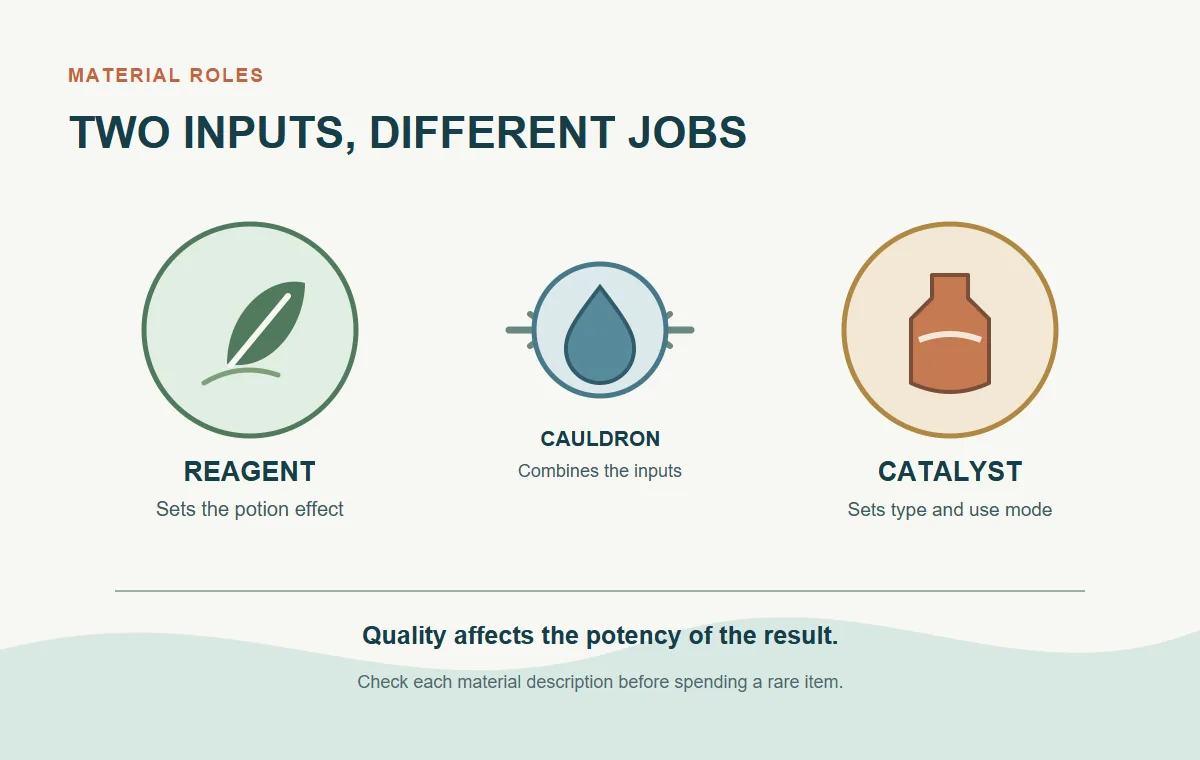
A reagent determines the potion effect. A catalyst determines the potion type, including how the potion can be used. Some potions are consumed by the player; others are applied in a different way, such as being thrown at an enemy. Both material families have quality, and the inspected Brewing reference says quality changes the potency of the effect.
| Part | What it controls | What to check |
|---|---|---|
| Reagent | The potion effect | Effect name, ingredient quality, and whether the effect fits the activity. |
| Catalyst | Potion type or use mode | Whether the potion is consumed, thrown, or applied another way. |
| Brewing skill | Quality and later crafting options | Current level milestones and the quality of the materials you plan to spend. |
Arcane Odyssey Brewing Guide: A Reliable First Brew
Use this workflow when you are learning the system or returning after an update. It is designed to make the result easy to inspect, not to claim a guaranteed best recipe. Start with a repeatable common material so that one failed experiment does not consume a rare drop.
- Choose the job. Pick one upcoming activity and name the problem a potion should solve: survivability, a utility effect, or an effect to apply to a target. A specific job is easier to evaluate than “make something strong.”
- Read the reagent first. Confirm its effect and quality. If you cannot tell what it contributes, pause and check the live item information rather than guessing from its name, color, or where it was collected.
- Choose the catalyst separately. Confirm how the resulting potion is used. This matters because a potion that is thrown or applied differently may suit a fight, while a potion meant to be consumed may be better for preparation.
- Find a convenient cauldron. Use a nearby island or your Brig when that is safer than sailing into a dangerous range. Keep travel and return plans in mind if the materials came from a risky area.
- Brew one test batch. Record the reagent, catalyst, material quality, and Brewing level. Inspect the effect, use mode, and potency before repeating the combination or increasing the value of the materials.
- Scale only after the result is useful. Repeat with better quality materials or an upgraded workstation only when the first result fits the job. If it does not, change one input at a time so you know what caused the difference.
This small test loop is more reliable than copying a recipe without context. A recipe can be accurate and still be a poor choice for your inventory, current skill, route, or planned fight. Keep a short note of successful combinations and update it when the game changes how an ingredient or potion behaves.
Where to Find Cauldrons
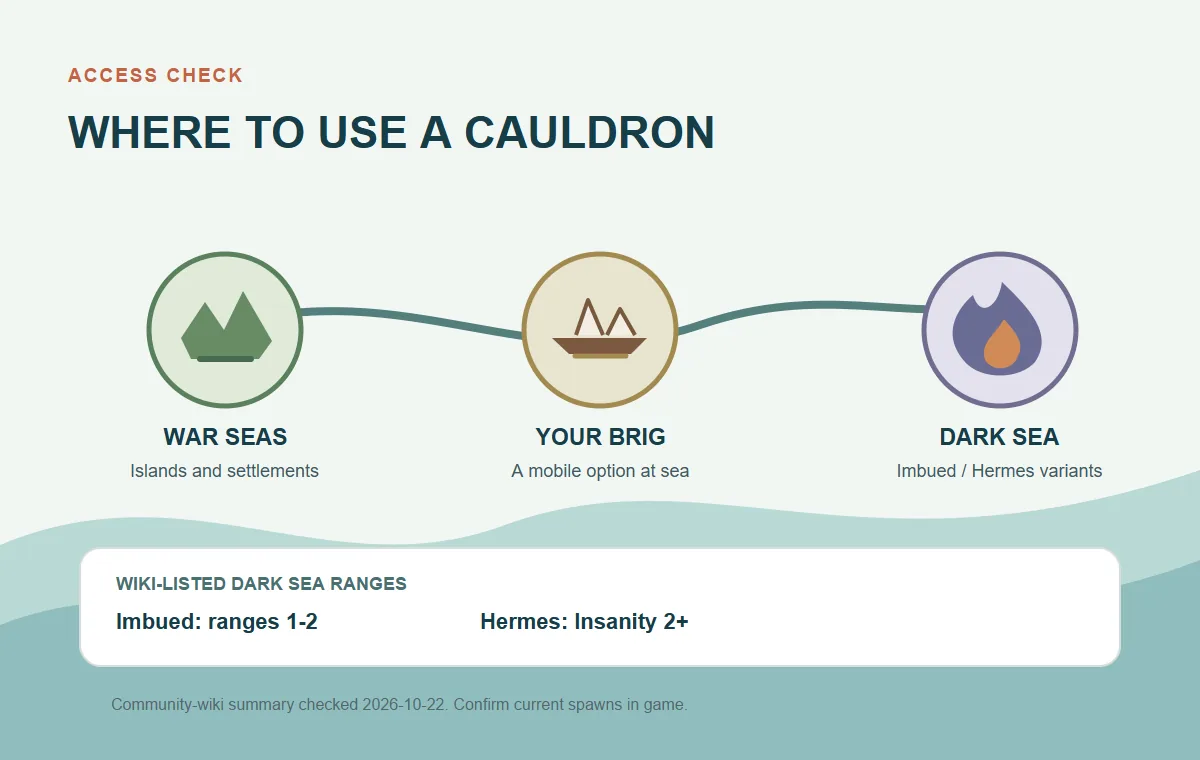
The community wiki describes cauldrons across the War Seas on many islands and aboard the Brig. That gives you both fixed and mobile options. If you are already near an island workstation, brewing there can keep a simple trip simple. If you expect to collect materials across several stops, the Brig can make crafting part of a longer route.
The same reference lists two Dark Sea variants. Imbued Cauldrons are described in the first and second ranges. Hermes Cauldrons are listed in Insanity 2 and higher ranges. The wiki reports higher potency and drachma value multipliers for those variants, but Dark Sea access adds travel and survival risk. Do not enter a difficult range only for a bonus unless the rest of your run already justifies that risk.
A practical rule is to treat a stronger cauldron as an optional efficiency boost, not as a requirement for learning Brewing. First get comfortable with material roles and result inspection in a safe place. Then decide whether a special cauldron is worth visiting for the potion batch you actually need. For Dark Sea route planning, read our Dark Sea Guide before adding a workstation detour.
Brewing Skill, Quality, and Progression
Brewing skill advances through crafting. The inspected community table connects later levels with higher potion quality and additional options. Its listed milestones include Good quality at level 2, Great at 3, Superb at 4, Excellent at 5, and Perfect at 7. Treat the exact level table as a current reference rather than a permanent promise, and check your in-game skill display if a patch changes progression.
| Listed milestone | What it can change | Practical use |
|---|---|---|
| Levels 2-5 | Brewing quality progresses from Good through Excellent. | Revisit common recipes as quality improves; a stronger ingredient may be worth using later. |
| Level 6 | The reference lists an option to use two reagents, with slightly lower effect potency. | Compare the combined utility with a single clear effect instead of assuming more inputs are always better. |
| Level 7 | The reference lists Perfect quality. | Use this as a reason to review stored combinations, not to spend every rare material immediately. |
| Later levels | The reference lists a higher positive-effect cap, increased potion output, and unstable potion crafting. | Check the current game and skill panel for the exact unlock level before planning around it. |
You can level by brewing repeatedly, but the community reference says higher-quality potions grant more experience than lesser ones. That makes material choice a progression decision: use common ingredients to learn how the system works, then consider better materials when you can predict the result. Do not assume a more expensive input gives the best experience per item without comparing what it consumes.
Unstable Potions and Shorter Effect Windows
At a later Brewing milestone, the inspected wiki describes unstable potions made by brewing with two different reagents or combining two potions made with the same catalyst at a cauldron. The tradeoff is duration: the reference says unstable effects last about sixty percent as long as regular effects. That can be acceptable when you need a short window, but it is risky when your activity depends on a long buff.
Before combining anything, compare the source potions and ask whether both effects matter at the same time. A pair with unrelated jobs can be less useful than one dependable potion. Use a low-cost test if possible, check which effects remain, and verify their durations in the current game. The exact behavior is a game mechanic that may be revised, so use the live item tooltip as your final check.
Common Brewing Problems and Checks
| Problem | Likely check | Next move |
|---|---|---|
| The effect is not what you expected | Reagent identity and current description | Change the reagent only, then test again with a known catalyst. |
| The potion is used differently | Catalyst role and resulting potion type | Read the use mode before carrying it into a fight. |
| The potion feels weak | Material quality, skill level, and any special cauldron effect | Compare one factor at a time instead of replacing every ingredient. |
| A recipe or spawn does not match a guide | Patch date and in-game tooltip | Prefer the current game state and check whether the reference page changed. |
Keep your test notes simple: material names, quality, skill level, cauldron type, and the result. If an outcome changes after an update, that record helps you identify whether the reagent, catalyst, workstation, or skill rule moved. Avoid turning one surprising result into a universal recipe claim until you can repeat it.
Sources and update-sensitive details
Brewing mechanics and Dark Sea cauldron variants were checked against the community wiki on October 22, 2026. No fixed reagent recipe is presented as guaranteed because game updates can change item behavior.
Arcane Odyssey Brewing FAQ
What does Brewing do in Arcane Odyssey?
Brewing is a crafting profession that combines reagents and catalysts at a cauldron to produce potions. Reagents provide the effect, while catalysts determine the potion type or how it can be used.
How do you brew a potion in Arcane Odyssey?
Choose the effect you need, check the reagent and catalyst descriptions, then use them at an accessible cauldron. Brew a common combination first, inspect the result, and only then spend rare materials.
Where can I find a cauldron?
Community references list cauldrons across the War Seas and aboard the Brig. The Dark Sea also has Imbued and Hermes variants in higher-risk ranges. Confirm the current spawn in game before making a long trip.
What is the difference between a reagent and a catalyst?
A reagent determines the potion effect. A catalyst determines the potion type or its use mode, such as a potion meant to be consumed or applied differently. The quality of both materials affects potency.
Does Brewing skill level matter?
Yes. The Brewing skill improves potion quality and unlocks additional options as it advances. The community wiki currently lists milestones for two reagents, extra potion output, a higher positive-effect cap, and unstable potions.
Are unstable potions always better?
No. The inspected community reference says unstable effects have shorter durations than regular potions. Combine effects only when the shorter window suits the encounter, and test the result before relying on it.
Final Takeaway
The takeaway from this Arcane Odyssey brewing guide is a simple loop: pick an effect, understand the reagent and catalyst separately, use a convenient cauldron, and inspect the potion before spending more materials. Skill and special cauldrons can add value, but a clear test result is more useful than a copied recipe you cannot verify.