
Navigation and route guide
Arcane Odyssey Dark Sea Map & Navigation Guide
The Arcane Odyssey Dark Sea map is most useful as a route-and-return framework, not as a promise of fixed treasure coordinates. Start with the edge of normal waters, use landmarks and current in-game sensing clues to keep your bearings, and decide how you will leave before you sail deep enough to lose the route.
Reviewed August 10, 2026. Dark Sea mechanics and terminology can change; this guide separates durable navigation habits from version-sensitive details.
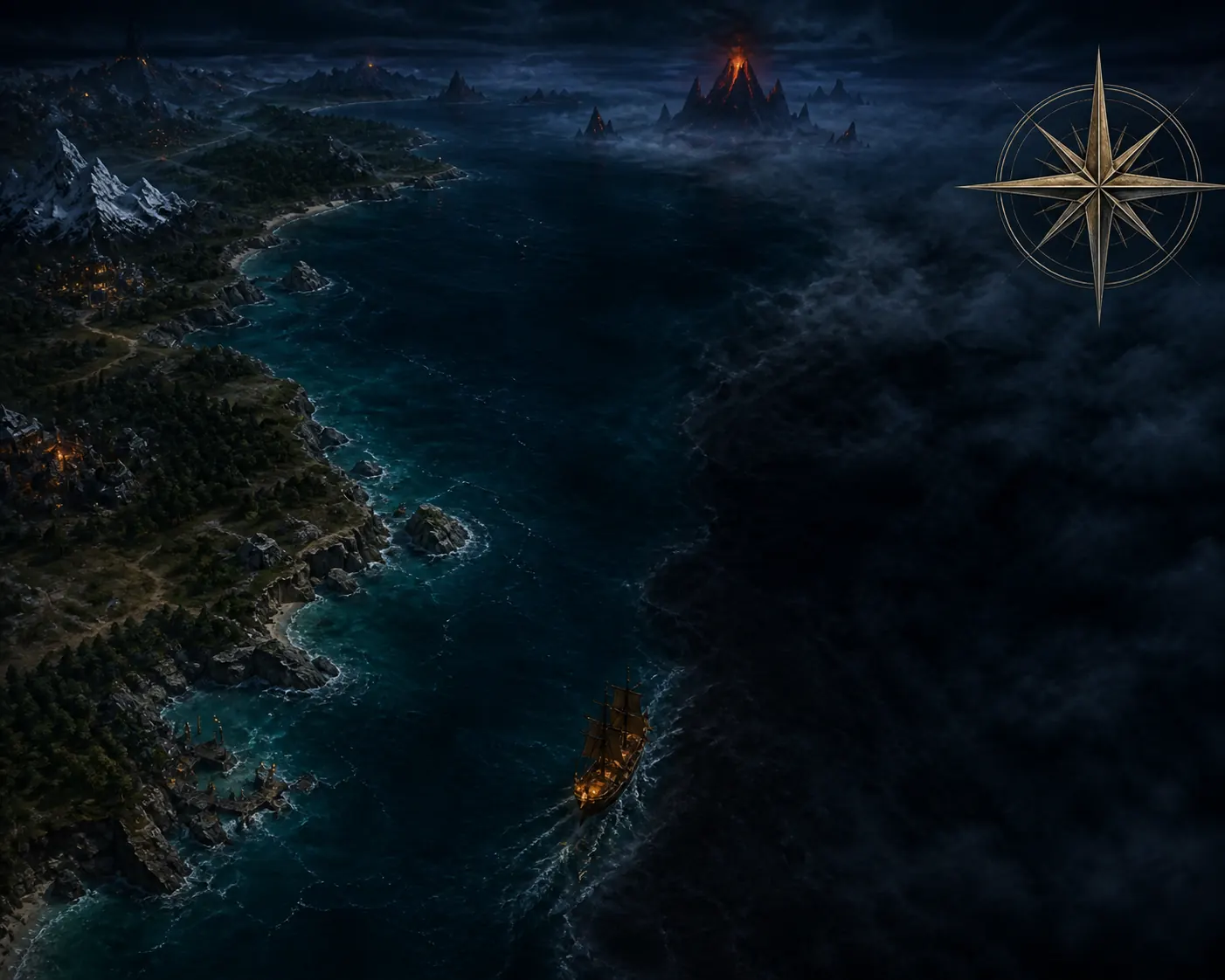
Arcane Odyssey Dark Sea Map: The Quick Answer
Use the Dark Sea map to answer four questions: where normal waters end, which landmarks can keep your route legible, how far you can safely scout, and which direction brings you back out.
This page is narrower than the Dark Sea preparation and loot guide. That guide covers preparation, ranges, insanity pressure, Dark Sealed Chests, and extraction. This page focuses on the navigation problem that comes before those choices.
What a Dark Sea Map Is—and Is Not
A normal sea map is comfortable because islands and ports give you repeated reference points. A Dark Sea route is harder to read. Fog can make two directions feel similar, the shoreline may disappear, and a profitable detour can quietly turn into a long return trip.
It is a navigation frame
Use it to understand the boundary, broad direction, nearest landmarks, and turn-back point.
It is not a fixed loot grid
Do not read an editorial illustration as a coordinate database. Routes and hazards can change.
How to Navigate the Dark Sea
The question how to navigate Dark Sea Arcane Odyssey is a request for a repeatable loop. Set a return direction, scout shallow water, remember one strong landmark, and make the route reversible before pushing deeper.
- 1Set a return direction before entering the fog.
- 2Scout shallow water and read the current visibility, handling, and sensing feedback.
- 3Keep one strong landmark in memory instead of a long list of vague turns.
- 4Pause after each target check and decide whether the route is still reversible.
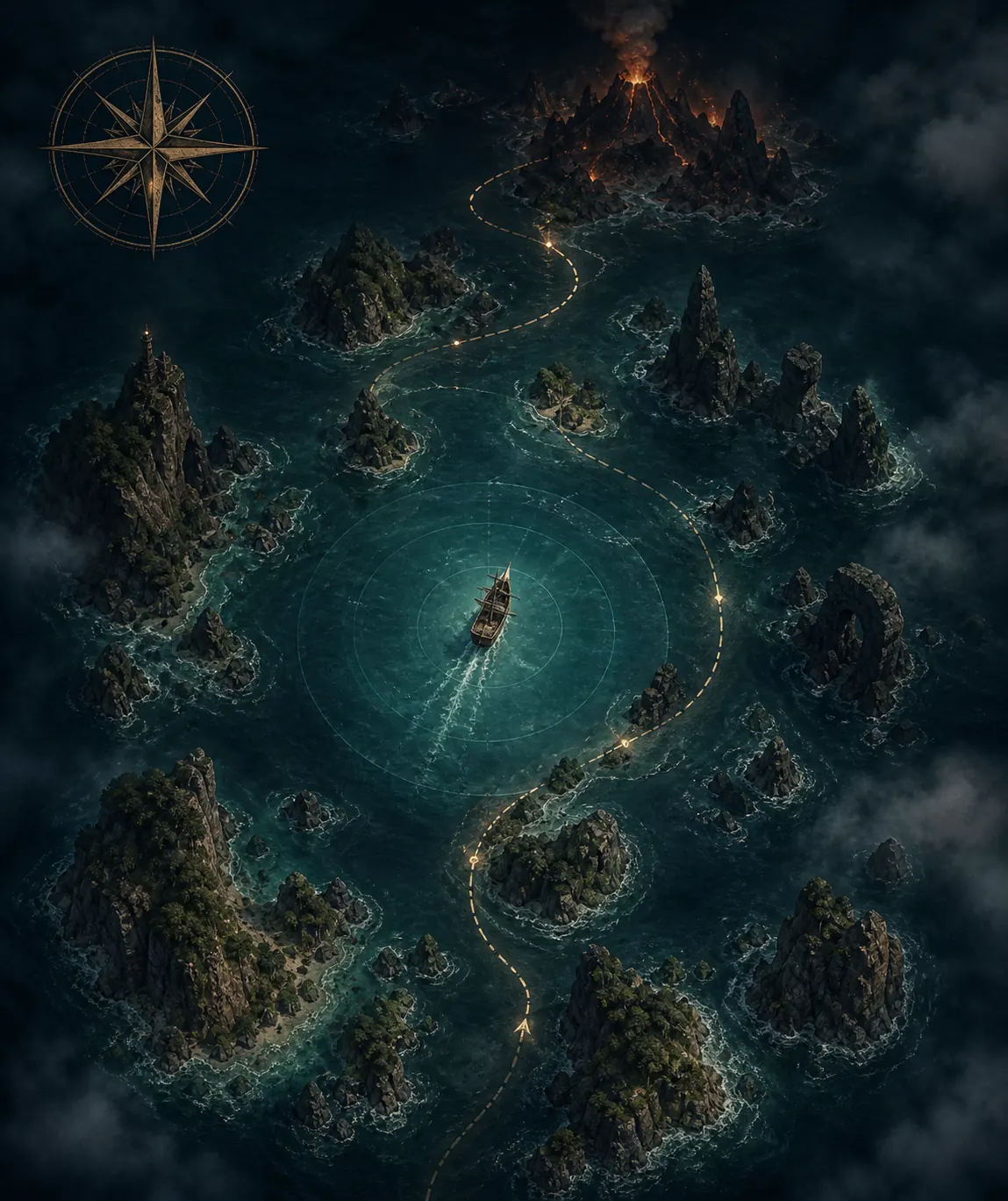
A Dark Sea Route Workflow That Is Easy to Repeat
| Run stage | Map question | Good stopping signal |
|---|---|---|
| Entry | Which side of normal waters am I leaving, and what broad direction will take me back? | You can name the return side before the fog closes around the ship. |
| Shallow scout | What can I see, sense, and use as a landmark right now? | Visibility, ship handling, and one reference shape are clear enough to continue. |
| Target check | Is the next structure or island close enough to justify the detour? | You know the reward goal and the return direction, not just the next shiny object. |
| Turn-back test | Can I still reverse the route with the current ship health and visibility? | Any uncertainty about route memory, supplies, or ship condition means it is time to leave. |
| Extraction | Which visible or remembered landmark points toward normal waters? | The return trip is the planned final stage, not an emergency afterthought. |
Dark Sea Compass, Sensing, and Current Terminology
Searches for Dark Sea Compass Arcane Odyssey are common because older guides and player conversations use compass language. Treat that phrase carefully: UI labels and sensing rules can change. Confirm the current game feedback, combine it with a landmark, and keep a return direction that still works if the signal disappears.
Map
Broad orientation and normal-water context.
Compass wording
A useful search phrase, but version-sensitive.
Sensing clue
Helpful feedback, never a substitute for a reversible plan.
Dark Sea Charts, Volcanoes, and Route Clues
Arcane Odyssey Dark Sea chart searches can mean a map image, route clue, or location question. Keep that intent separate from the Treasure Chart Guide and Treasure Chart Locator. Volcanic silhouettes can be memorable visual landmarks, but their exact hazards and interactions are version-sensitive.
How to Exit the Dark Sea Safely
Answer how to exit Dark Sea Arcane Odyssey before entering. Decide what ends the run: a small target count, ship-health threshold, poor visibility, a lost landmark, or the moment you can no longer explain the route home.
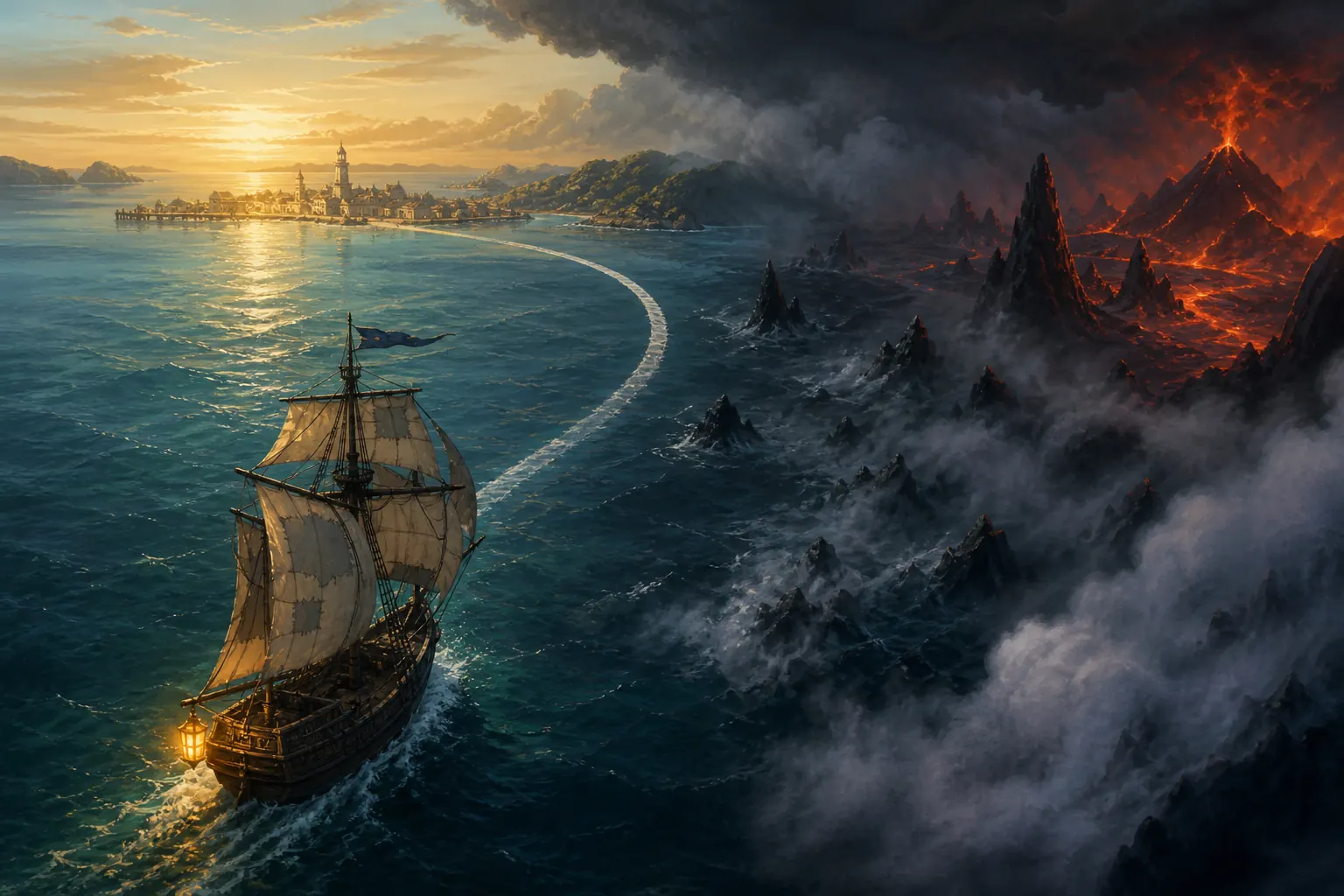
- Stop adding risk after the target is good enough.
- Turn toward the remembered normal-water side instead of inventing a new route.
- Leave loot behind when the return risk is larger than the reward.
- Review the run so the next route becomes memory, not guesswork.
For preparation, ranges, insanity pressure, Dark Sealed Chests, and broader loot planning, continue to the Arcane Odyssey Dark Sea Guide.
Arcane Odyssey Dark Sea Map FAQ
Is there a Dark Sea map in Arcane Odyssey?
Treat a Dark Sea map as a navigation framework rather than a permanent treasure-coordinate sheet. Use normal-water orientation, landmarks, current in-game feedback, and a clear exit plan together.
How do you navigate the Dark Sea in Arcane Odyssey?
Set a broad return direction, scout shallow water, identify one strong landmark, use current sensing clues without depending on them, and stop when the route or ship condition becomes uncertain.
What is the Dark Sea Compass in Arcane Odyssey?
Compass wording is version-sensitive. If an older guide describes a dedicated Dark Sea Compass, check the current game UI and recent update or community references before treating that behavior as permanent.
How do you exit the Dark Sea in Arcane Odyssey?
Turn back before the run becomes an emergency. Keep the return direction or landmark in mind, sail outward toward normal waters, and use a target or ship-health limit instead of waiting for a perfect final find.
What do the volcanoes do in the Dark Sea?
Volcanic shapes can be memorable visual landmarks, but their hazards and interactions may be version-sensitive. Use them to orient your route and verify current behavior in-game rather than assuming every volcano has the same role.
Is this the same as the Treasure Chart Locator?
No. This page explains Dark Sea navigation and route decisions. The Treasure Chart Locator is the right tool when you already have a Treasure Chart and need to solve its direction, distance, and terrain clues on a supported island.
The Short Version
Use the Arcane Odyssey Dark Sea map to keep the route reversible. Choose a return direction, scout shallow water, remember one landmark, treat compass and sensing terms as version-sensitive, and leave while the ship and route are still under control.
Sources and Media Note
This page was checked against first-party Arcane Odyssey destinations and community references on August 10, 2026. The three local images are Arcane Tools editorial illustrations, not official screenshots or Roblox UI captures.
- Official Arcane Odyssey Roblox page
- Official forum and official Trello board
- Community Wiki Dark Sea reference — community source, not official documentation.