
Arcane Odyssey Magic Guide: Best Magic, Pairings, and Build Tips
The best Arcane Odyssey magic is the one that fits your class, spell timing, armor stats, and second magic plan. Use this guide to choose a magic path without treating a tier list as a permanent rule.
Published | Updated | By Arcane Tools Editorial Team
Fast answer
If you are new, start with a magic that matches your comfort: Fire for direct pressure, Lightning for speed, Water or Ice for setups, Earth or Metal for heavier trades, and Wind for spacing.
Then use the Armor Build Calculator to support that plan with power, defense, size, speed, range, or agility.
For official game context, see the Arcane Odyssey page on Roblox.
Best for beginners
Fire, Lightning, Water, Ice, Earth, and Wind are easy starting points because their combat roles are clear. Pick the one whose rhythm you can actually land under pressure.
Best for pairing
Pairings work best when one magic sets up a status, spacing pattern, or punish window that the other can use. Randomly combining two high-tier magics often performs worse than a planned pair.
Best with gear
Magic builds change dramatically once armor stats enter the picture. Power, size, speed, range, defense, and agility can turn a comfortable magic into a reliable build.
On this page
How to Decide the Best Magic in Arcane Odyssey
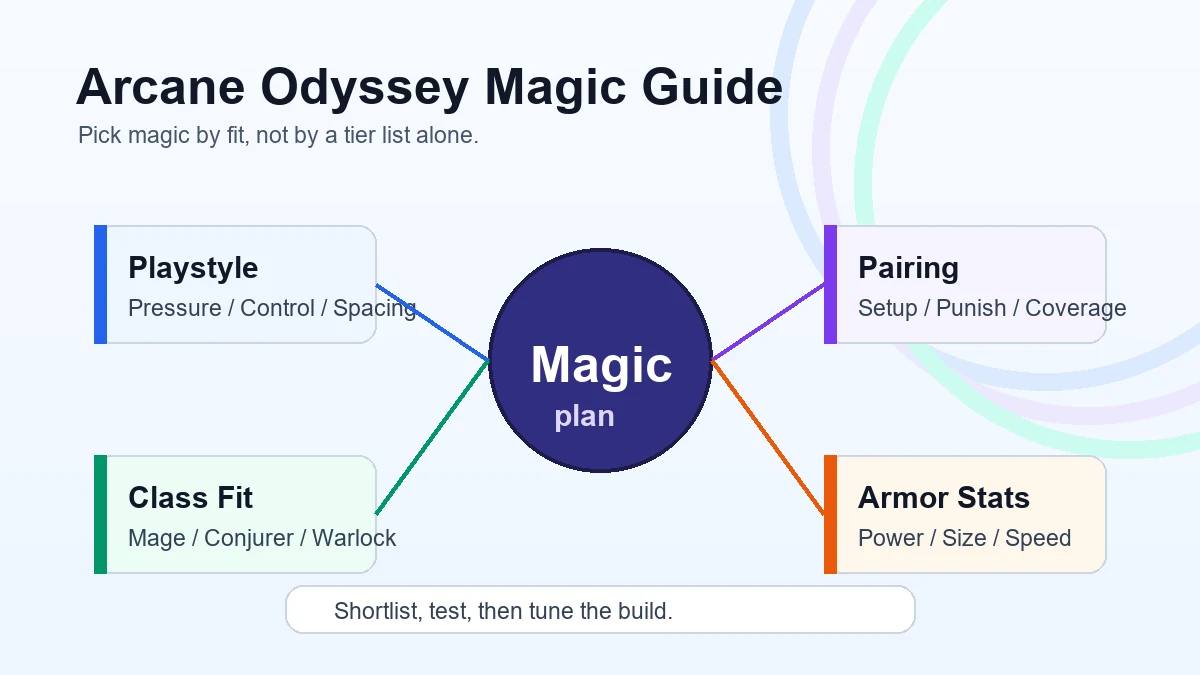
Search results for magic Arcane Odyssey and Arcane Odyssey best magic usually imply a simple ranking question, but the real decision is more useful when you split it into four parts: what your first magic does well, what your second magic adds, what your class can use, and what your armor stats reinforce. A magic that feels excellent for a pure Mage may feel awkward for a Conjurer who spends more time creating weapon openings. A high-damage magic can also feel weak if it is too slow for the fights you choose.
Start by asking what you need your magic to solve. If you miss often, a larger spell size or cleaner control pattern may matter more than raw damage. If you win openings but lose trades, defense and steadier punish windows may be more valuable. If you are building around mobility, a magic with fast pressure or good spacing will usually feel better than a slow element that only looks strong on paper.
Practical rule
Treat tier lists as a scouting report. Use them to notice popular choices, then test whether the magic still works after you account for your class, second magic, armor stats, and the types of fights you actually take.
Starter Magic Choices by Playstyle
A good starter magic should feel readable while you are still learning spell shapes, cooldowns, movement, and enemy behavior. Fire is a natural pick for players who want straightforward pressure. Lightning suits players who like fast responses and punish timing. Water and Ice reward setup thinking because they invite you to plan around status pressure and follow-up attacks. Earth and Metal are more comfortable for players who prefer heavy hits and steadier trades. Wind gives spacing-focused players a clear identity without forcing them into the slowest rhythm.
Do not choose only because someone calls a magic “best.” Choose because you understand what problem it solves. If you are often late to react, a very fast magic might help. If your aim is inconsistent, larger area coverage may help. If you want a later Mage route, think ahead to second magic pairing before you commit too emotionally to the first element.
Second Magic Pairings and Synergies
The strongest magic pairings usually have a purpose. One magic may create a status or spacing condition, while the second magic punishes that condition. Another pair may cover a weakness: a slower heavy magic can be supported by a faster option, or a control magic can be supported by a more direct finisher. This is why two individually popular magics can still make a clumsy pair if they ask you to fight in contradictory ways.
| First magic | Common pairing ideas | Why it works | Watch out for |
|---|---|---|---|
| Fire | Ash, Magma, Explosion | Pressure damage and area denial | Can feel predictable if your gear has no speed or range support. |
| Water | Ice, Lightning, Snow | Status setup, control, and flexible team play | Needs deliberate spell timing so the setup does not become wasted tempo. |
| Ice | Water, Snow, Crystal | Freeze pressure and punish windows | Strong control is less useful if you cannot consistently land follow-up hits. |
| Lightning | Water, Wind, Light | Fast punish routes and mobility-friendly duels | Lower patience for mistakes; missed spells can leave you exposed. |
| Earth | Metal, Crystal, Wood | Heavy hits, defensive rhythm, and slower trades | Requires planning because faster opponents may force awkward casts. |
| Wind | Lightning, Light, Snow | Spacing, movement, and ranged control | Usually wants gear that supports speed, size, or range rather than pure damage only. |
Use this table as a planning framework, not a locked list. Game balance, spell customization, and personal execution can change what feels best. The important part is to explain the pairing before you farm around it: “this magic sets up control, this one punishes,” or “this magic gives pressure, this one covers range.” If you cannot explain the pair, test it before committing rare resources.
Mage, Conjurer, Warlock, and Paladin Fit
Magic advice changes once class identity enters the build. A Mage can justify deeper second-magic planning because the build leans heavily on spell coverage and elemental interaction. A Conjurer needs to think about weapon openings: the right magic should help create or secure those openings instead of pulling the build into a completely different range. A Warlock cares more about pressure, chase, and melee follow-up. A Paladin often wants stability, sustain, and control more than a fragile damage race.
| Build path | Main magic decision | Useful check |
|---|---|---|
| Mage | Second magic choice | Pick a magic pair with a status or tempo plan instead of two random favorites. |
| Conjurer | Weapon compatibility | Choose magic that supports weapon openings and does not fight your preferred range. |
| Warlock | Melee pressure | Favor magic that helps close distance, punish dodges, or create safer trade windows. |
| Paladin | Sustain and control | Avoid copying glass-cannon magic advice if your goal is stable survival. |
If you are unsure which path you will take, choose a flexible magic rather than a narrow one that only feels good in a finished build. Flexibility is especially helpful while leveling because your gear, spell options, and combat habits will change. You can always refine the build once your class direction is clearer.
Armor Stats That Support Magic Builds
Magic choice and armor choice should not be separate decisions. Power raises damage, but it is not the only stat that matters. Defense gives you more space to learn a slower magic. Size makes some spells easier to connect. Speed and agility help aggressive or evasive players keep the fight in a comfortable range. Range can make spacing-focused magic more consistent, while resistance and regeneration can matter when you expect longer fights.
After you choose your magic plan, open the Arcane Odyssey Armor Build Calculator and set stat weights that match the plan. A Fire pressure build may value power and size. A Lightning build may care more about speed and clean repositioning. A heavier Earth or Metal setup may need defense so you can survive while trading. This is where many “best magic” claims become less useful: they ignore the equipment that makes the magic comfortable.
When a Magic Tier List Is Still Useful
An Arcane Odyssey magic tier list can still help if you read it correctly. It can show which magics players are testing, which ones are popular after updates, and which pairings deserve attention. The mistake is treating a list as a substitute for build planning. A tier list rarely knows your class split, armor limitations, spell preferences, or whether you are focused on PvE, PvP, treasure routes, or general progression.
A better workflow is simple: shortlist two or three magics, identify the pairing or class reason for each, test whether the spells feel natural, then tune armor stats around the winner. That gives you a build you understand instead of a borrowed answer you cannot adjust.
Related Arcane Tools Guides
If your magic decision is part of a wider progression plan, combine this page with the Armor Build Calculator for gear stats, the Arcane Odyssey Map Guide for sea and island routing, and the Chest Locations Guide when you need repeatable loot routes for upgrades. Treasure-focused players can also use the Treasure Chart Locator after farming charts.